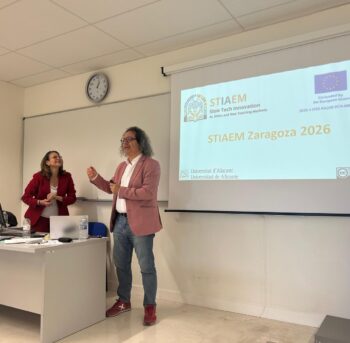









STIAEM
STIAEM PROJECT

Slow Tech in Education and Artificial Intelligence

The integration of artificial intelligence into the educational context must be sustainable, ethical and grounded in pedagogical principles. Let’s rethink the relationship between education and digital technologies, prioritising the wellbeing of students and teachers.

The four pillars

The STIAEM pedagogical model

An innovative, human-centred educational framework. AI is not merely automation, but a ‘co-creator’ supporting education, ensuring that human beings always remain at the centre of the learning process.

Rectangle
Rectangle
International Partners
9
Objectives

Guiding principles for the ethical integration of AI

The STIAEM project enhances teachers’ digital skills and promotes the responsible integration of Artificial Intelligence in schools. Through research, training and experimentation, the project aims to define an educational model that can be replicated across Europe, aligning the use of AI with sound pedagogical and ethical principles.
To ensure the sustainability of the results, a hybrid hub (physical at the University of Foggia and digital) will be created for continuing professional development and research.

Methodological development
The project is based on a rigorous pedagogical model in which AI is a tool to support learning, not an end in itself. The approach is grounded in the principles of Universal Design for Learning (UDL) to ensure maximum inclusivity.
Educational innovation
We are innovating teaching and digital citizenship education. Through field trials, the project promotes active methodologies that empower students to become critical and tech-savvy co-creators.
Teacher training
We map teachers’ actual needs and offer practical training programmes: from international exchange programmes (“Go To School”) to dedicated digital tools, helping them develop comprehensive technical and pedagogical expertise.
Ethics and sustainability
In line with the ‘Slow Tech’ philosophy, the project places the student’s wellbeing at the centre. We develop guidelines and policy recommendations for the safe, fair and transparent adoption of technology.
Principal Investigator
Banner con
Focused on collaboration and networking
Home3 phone
Get in touch
Results

Results and final outputs

Upon completion of the project, STIAEM will deliver a series of concrete and transferable results to the educational community, designed to have a lasting impact

TIMELINE

A progressive and structured plan

1
Initial phase
The initial phase, from september 2025 to december 2025, is dedicated to launching the project and defining the methodological framework agreed upon by the partners.
2
Research activities
Between january 2026 and june 2026, research activities, data collection and the development of the reference pedagogical model will take place.
3
Pilot phase
Subsequently, between september 2026 and march 2027, the project will enter the pilot phase, with activities in schools and international mobility programmes enabling the solutions developed to be tested in practice.
4
Impact analysis
Finally, between march 2027 and august 2027, the impact analysis will be carried out, the final publications produced, and seminars and dissemination activities organised at european level.
Png process
The four work packages

Organisation and leadership

The implementation of the stiaem project is based on an approach of integrated international collaboration. The activities are organised into four work packages (wp), each of which is assigned to a partner with a specific coordinating role to maximise the impact of the results.

Vector2
Service icon
WP2 – Research and methodological development
This phase is dedicated to pure research and the definition of the basic pedagogical model. It also includes the design of the mooc and all the training tools envisaged by the project.
Vector2
Service icon
WP2 – Research and methodological development
This phase is dedicated to pure research and the definition of the basic pedagogical model. It also includes the design of the mooc and all the training tools envisaged by the project.
Vector3
001 abacus
WP3 – Testing and evaluation of AI in education
This focuses on testing the developed solutions directly in the field. Through activities in schools and international mobility schemes, the actual effectiveness of artificial intelligence in educational contexts is assessed.
Vector3
001 abacus
WP3 – Testing and evaluation of AI in education
This focuses on testing the developed solutions directly in the field. Through activities in schools and international mobility schemes, the actual effectiveness of artificial intelligence in educational contexts is assessed.
Vector6
007 budget
WP4 – Policy recommendations & guidelines
This works on defining policy recommendations and concrete operational tools to support teachers and decision-makers. The aim is to foster a constructive dialogue between the world of research and educational policy.
Vector6
007 budget
WP4 – Policy recommendations & guidelines
This works on defining policy recommendations and concrete operational tools to support teachers and decision-makers. The aim is to foster a constructive dialogue between the world of research and educational policy.
Vector5
005 bar chart
WP5 – Platform & dissemination
This work package is responsible for managing the ‘slow tech ai’ digital platform and all dissemination activities. The aim is to amplify the dissemination of the project’s results on a european and international scale.

Vector5
005 bar chart
WP5 – Platform & dissemination
This work package is responsible for managing the ‘slow tech ai’ digital platform and all dissemination activities. The aim is to amplify the dissemination of the project’s results on a european and international scale.

We are proudly operating on 5 countries globally now

1
EUROPEAN COUNTRIES
0
YEARS OF DEVELOPMENT
1
STRATEGIC PILLARS
1
PARTNER INSTITUTIONS
TEAM

The team and the european partnership

A broad and diverse international network, coordinated by the university of foggia. Nine institutions from five european countries have come together to innovate teaching through the informed and ethical use of artificial intelligence.

Let us help you get your project started.

Contact

 +44(0)20 3156


 +1 866 512 0268

Start your project